
Potting system for polyurethane potting
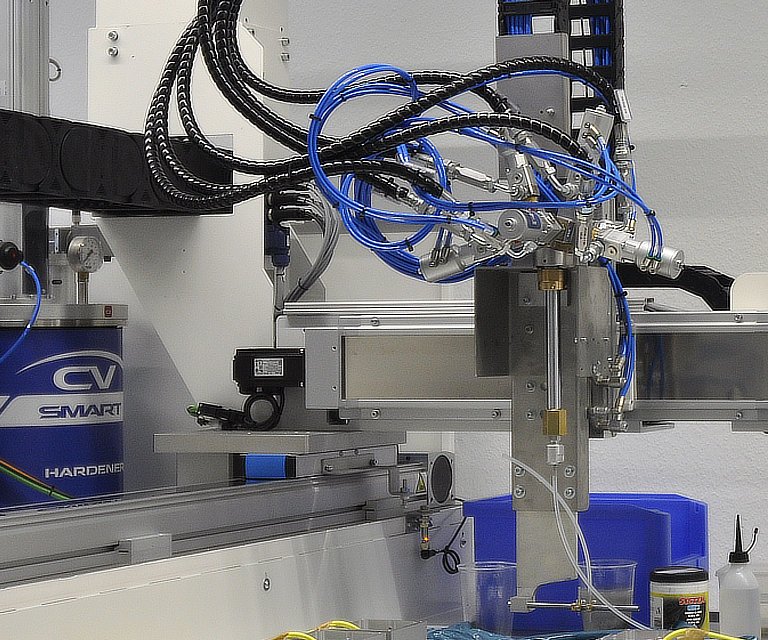
Since 2017, we have been potting our luminaires using an in-house CNC potting machine. The custom-built machine guarantees a consistently high-quality, transparent polyurethane (PU) potting compound for our luminaires. Before the actual potting process, the two components of the PU potting compound are drawn from 60 kg drums into stainless steel containers within the machine. In these containers, the two components are subjected to a strong vacuum, causing any moisture trapped in the compound to evaporate. This results in a transparent PU potting compound free of disruptive microbubbles.
Our polyurethane (PU) has a 1:1 mixing ratio. This is particularly advantageous when dispensing very small quantities. The dispensing head is controlled via a computer interface. Furthermore, we can also manually control the dosage, for example, for potting special luminaires.
Our NauticProfil system (NP system) is potted on tables using a precise 3-axis linear robot. This enables us to achieve a consistently reproducible quantity and quality for every NP-LightInsert.
FLASHAAR® Premium Coating
To protect against moisture, dust, vibration, mechanical stress, and other harmful environmental influences, we have been encapsulating our luminaires with a transparent polyurethane for many years. Until now, it has not been possible to supply encapsulated and unencapsulated luminaire inserts with precisely the same color for both indoor and outdoor use.
We have always carefully evaluated the optical properties of our resin to ensure that our PU preserves the color characteristics of the LED as much as possible. Nevertheless, when measuring the color temperature of the LED after encapsulation, we observed a shift in color temperature. It drifts from a warmer to a cooler color point. The higher the color temperature of the LED before encapsulation, the greater the color drift.
With our conventional PU encapsulation, the light is only emitted after passing through the PU. This leads to undesirable, clearly visible color shifts. This is due to the change in the refractive index at the interface between the phosphor layer and the PU, instead of in air as before.
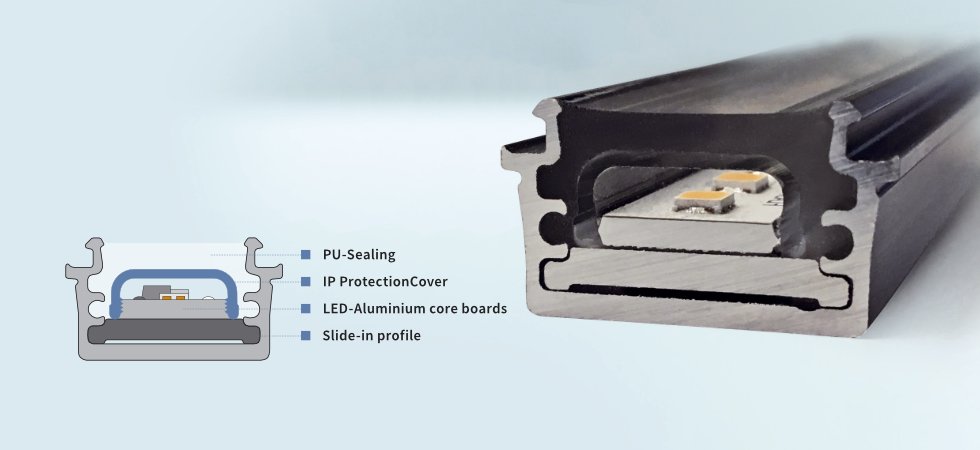
Our PremiumCoating is both simple and ingenious. Before the PU encapsulation, we clip the new IP ProtectionCover lengthwise over our high-quality LED aluminum core circuit boards. This minimalist cover conceals the LEDs, thus preventing direct contact with the casting resin, i.e., our PU. The refractive index remains unchanged, and the color coordinates are constant.
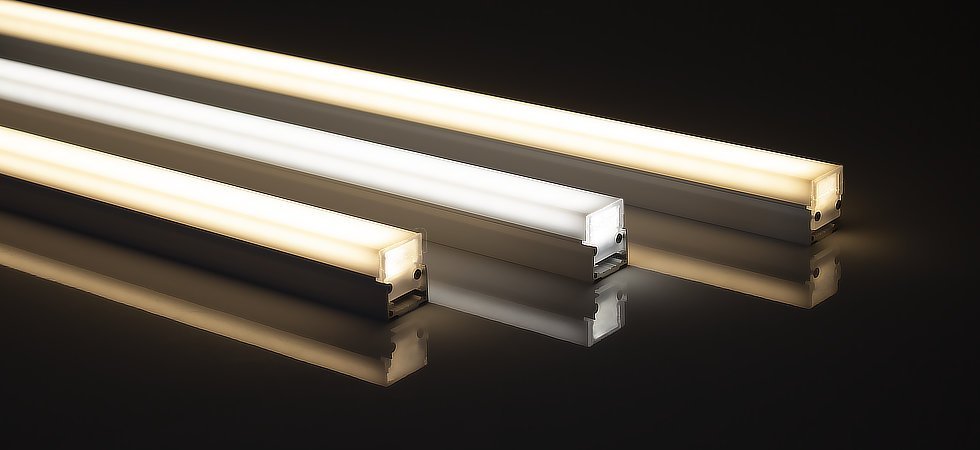
the luminaire inserts encapsulated using FLASHAAR PremiumCoating are optimized for combination with white-tinted covers. This technology guarantees an absolutely homogeneous, uniform, linear appearance.
What is the difference between polyurethane and silicone?
Polyurethane and silicone are both synthetic materials, but they have different properties and applications. Polyurethane is a thermoplastic polymer produced by the reaction of polyol and isocyanate. It is elastic, impact-resistant, and abrasion-resistant, and is commonly used in applications such as furniture upholstery, foam components, and coatings.
Silicone, on the other hand, is an elastomeric material made from silicon, oxygen, carbon, and hydrogen. It is heat-resistant, chemical-resistant, and has good electrical insulation properties. It is frequently used in applications such as gaskets, seals, and electronic components.
In summary, polyurethane is more suitable for applications where elasticity and impact resistance are important, while silicone is better suited for applications where heat resistance and chemical resistance are important.
Why are LEDs encapsulated in polyurethane? LED lights are often encapsulated in polyurethane (PU) to protect and insulate them. Here are some of the reasons why PU is suitable for this application:
- Elasticity: PU is an elastic material that gives the lights a certain flexibility to absorb shocks or vibrations.
- Impact resistance: PU is a very impact-resistant material that provides additional protection to the LED lights to prevent damage from impacts or vibrations.
- Insulation: PU has good insulating properties, which means it absorbs electrical disturbances and overvoltages that could damage the LED.
- Moisture resistance: PU is moisture resistant, which is particularly important when LED lights are used in humid environments.
- Easy processing: PU is easy to mold and process, making it easier to pour it around the LED lights to achieve a perfect fit.