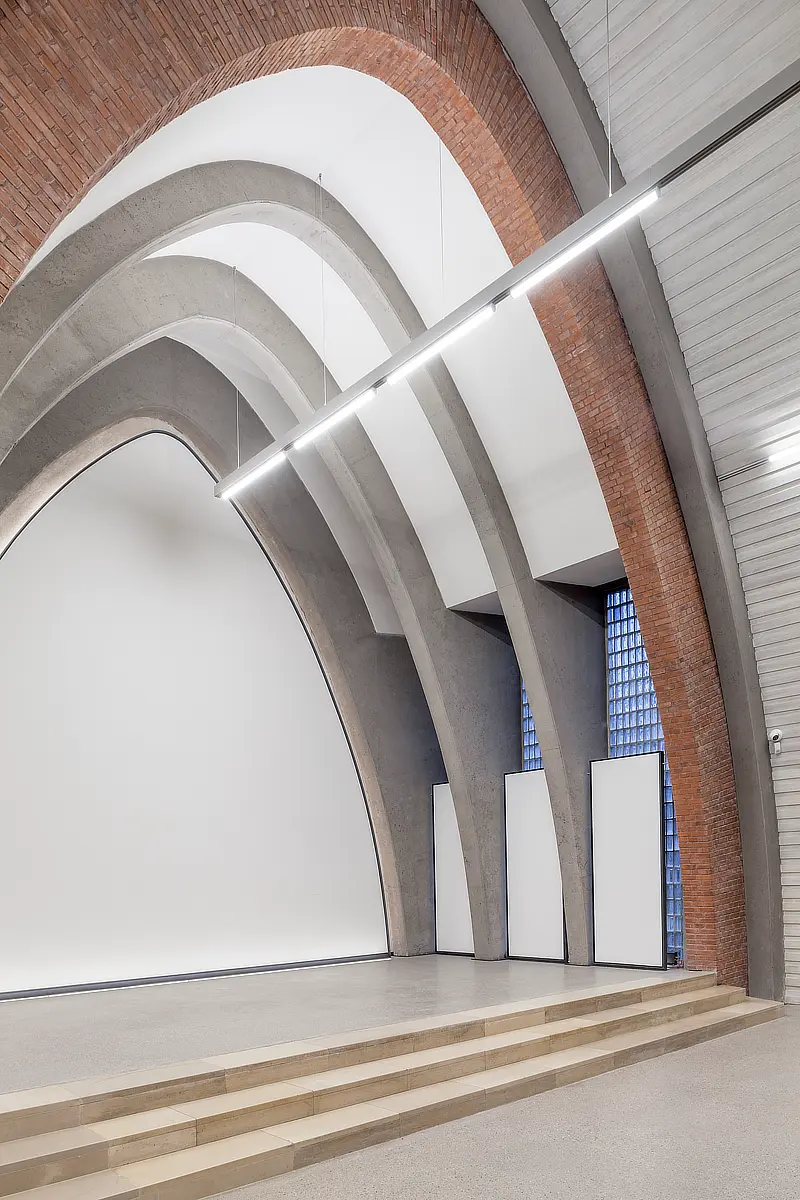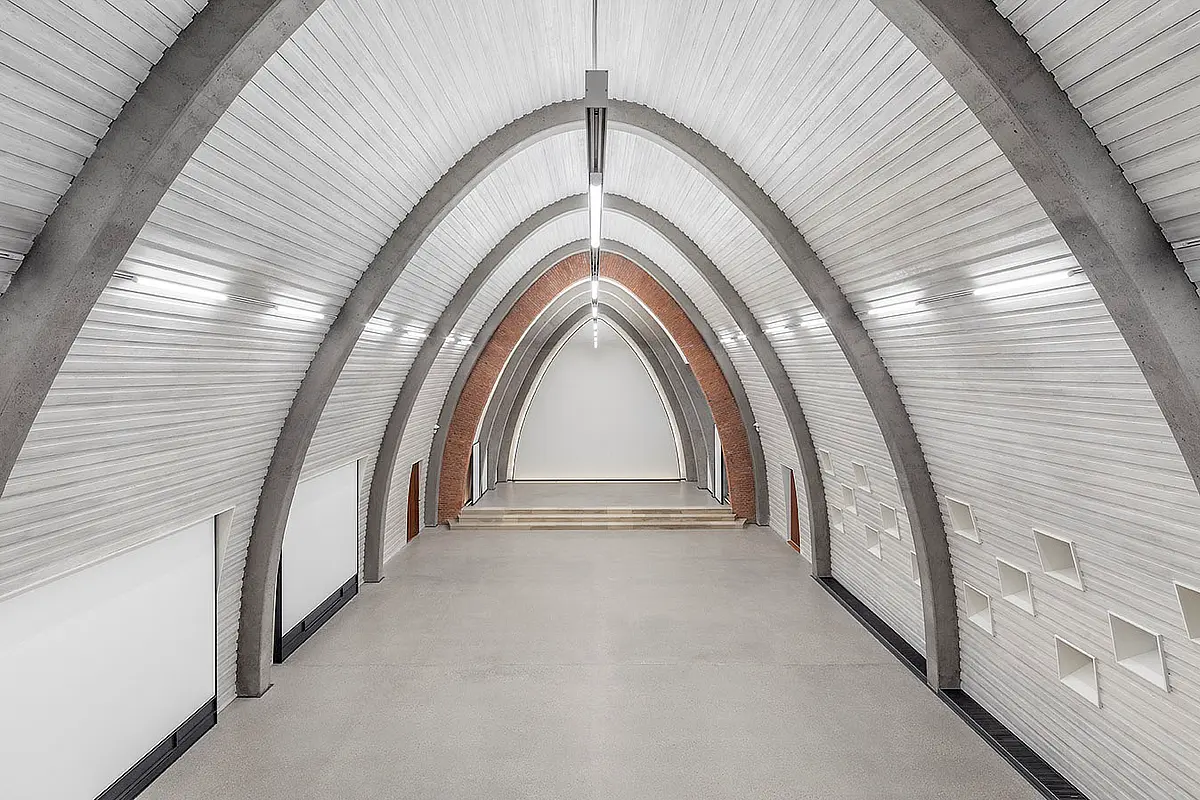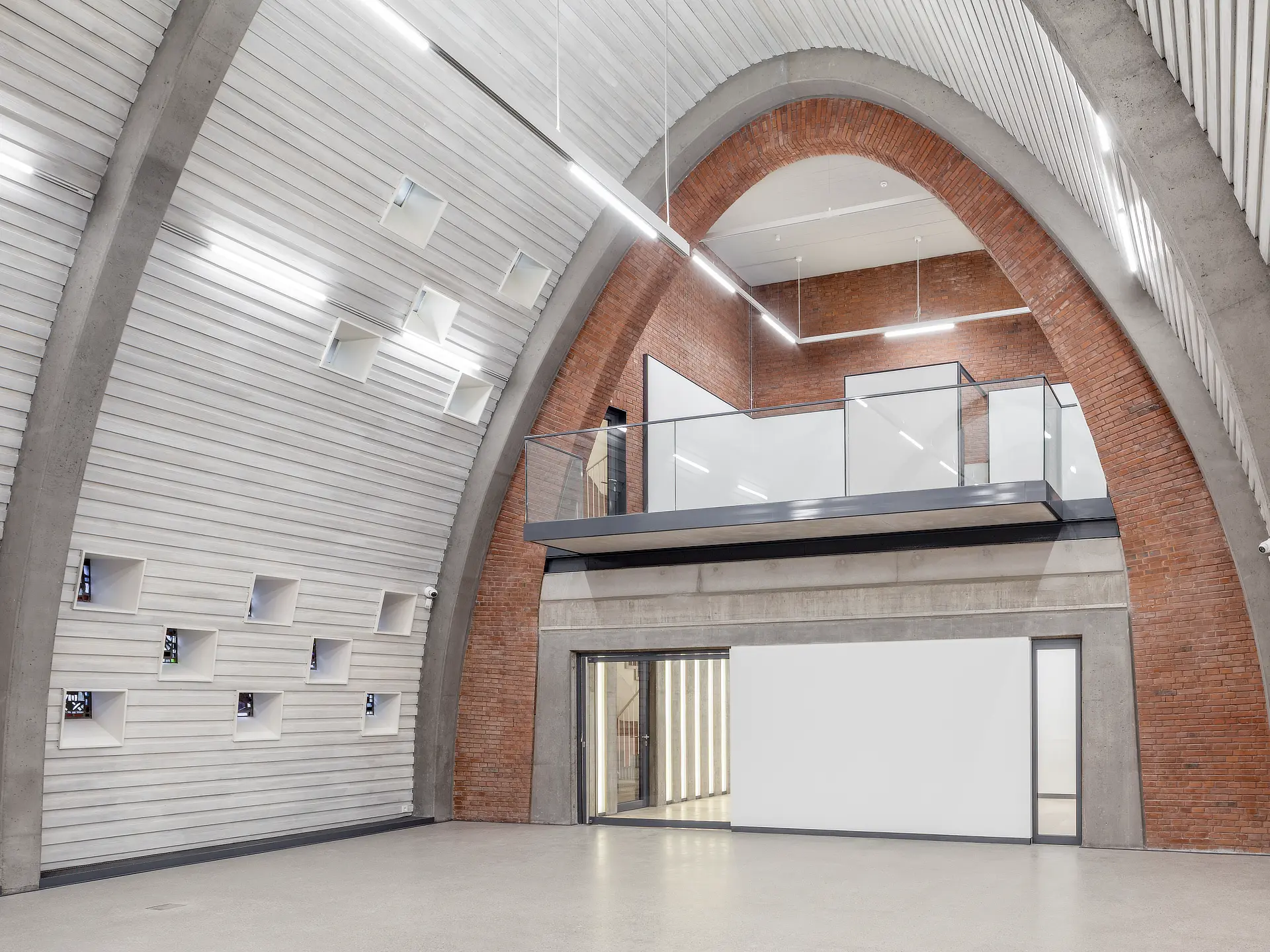
Linear light structures and neutral white light ensure even illumination and true color reproduction.
Consecrated in 1959, the Church of St. Nicodemus of the Evangelical Lutheran Church in North Hamburg-Ohlsdorf, designed by Henry Schlote, is characterized by a striking, parabolic supporting structure in its interior, reminiscent of an upturned ship, lending the space a light, spacious, and open feel. This structural geometry not only creates a distinctive spatial identity but also provides an excellent foundation for acoustic and lighting qualities – a "space full of light" that, in its original conception, was already suitable for the presentation of art.
Following its deconsecration in 2022, the building was transformed into the exhibition center "Parabel – Center for Art in Hamburg" under the planning of WRS Architects & Urban Planners, in close consultation with the heritage preservation office and the Dr. Maike Bruhns Art Collection Foundation. The conversion consistently followed the guiding principle of largely preserving the characteristic structural elements and spatial effect of the existing building while simultaneously creating a contemporary, flexible infrastructure for exhibitions.
The lighting concept plays a central role in the redesign, translating the existing building's architectural quality into a restrained, exhibition-oriented lighting strategy. Instead of a sacral, dramatic lighting scheme, the concept relies on uniform, linear ambient lighting in the form of continuous LED light lines along the central axis. These create a homogeneous, shadow-free light level that deliberately avoids creating a hierarchy within the space, focusing entirely on the exhibited artworks.
What is striking is the approach of not using light to emphasize individual architectural elements, but rather guiding it strictly along the spatial axis. This ensures that the distinctive parabolic shape remains clearly legible and creates a calm, controlled lighting atmosphere that allows the space to be experienced as a whole.
The choice of a neutral white light color supports a color-neutral rendering of the artworks and prevents material distortion. At the same time, the light sources are designed as narrow lines integrated into the architecture, visually receding into the background and not competing with either the expressive supporting structure or the exhibits. Light is thus consciously understood as an infrastructural medium – precise, understated, and functional.
Overall, the lighting concept creates a uniform, reliable basic brightness as a basis for curatorial interventions and, due to its neutrality, allows for a high degree of flexibility in use.
mounting profiles
NauticProfil® S1
H2flex U1 (indirect light shining upwards, Erco power rail below)
H2flex U1 (indirect light shining upwards, Erco power rail below)
lamp inserts
NauticProfil® Jago-2 | Cover Flat Frosted | 2700 + 6500K | CRI > 90
picture gallery